
The PMD
When the Most Selective Hatch of the Year Meets the Best Fish of the Year. A Pocket Water CO Field Guide

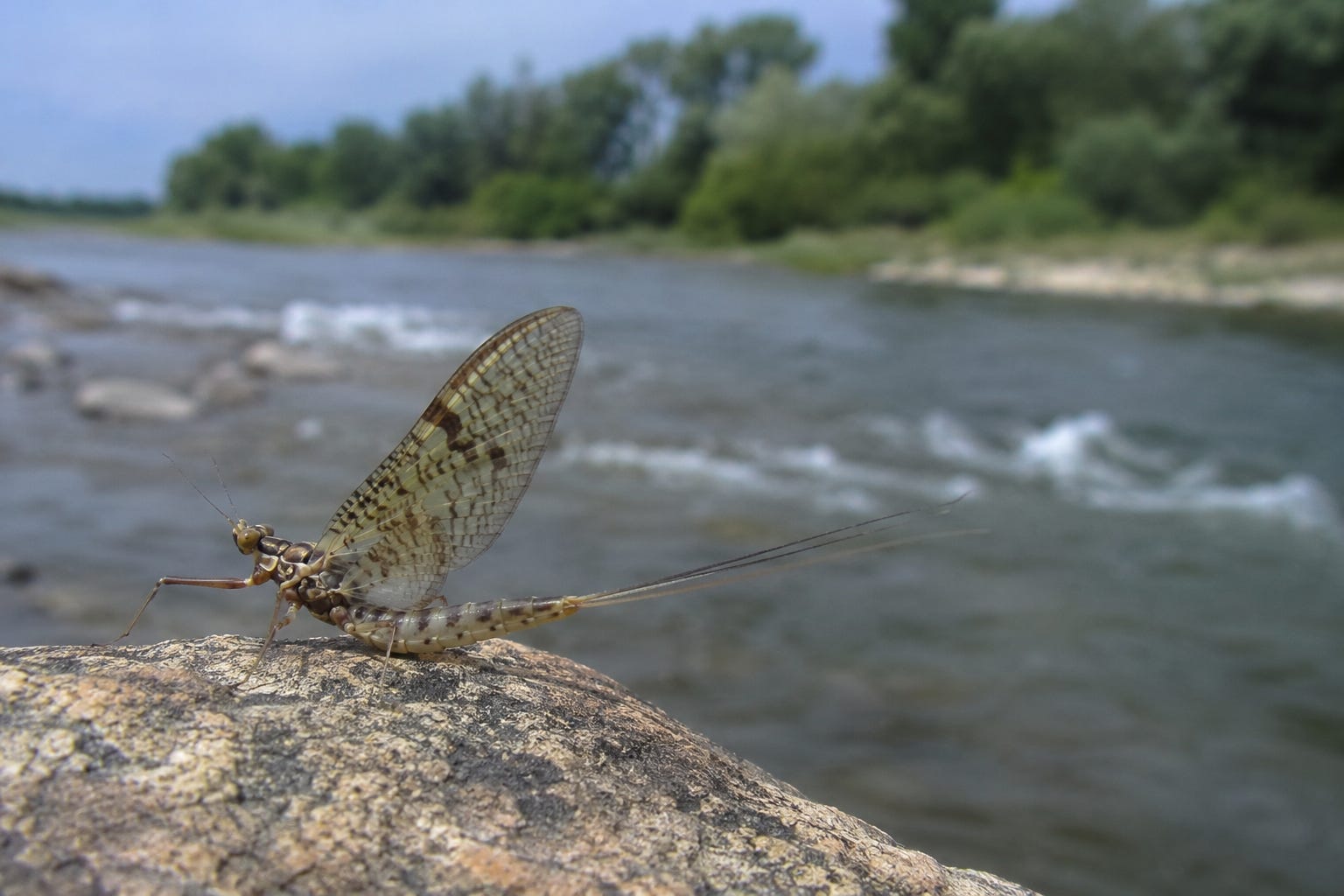
There’s a kind of madness that settles over an angler the first time they really get into a PMD hatch. Not the good kind of madness — the productive, fish-in-the-net kind. The other kind. The kind where you’ve got size 18 duns coming off in curtains, every fish in the flat is up and sipping, you’ve switched flies eleven times, and you haven’t touched a trout in two hours.
Welcome to Ephemerella infrequens.
The pale morning dun is not the most abundant hatch in Colorado. It’s not the year-round constant the midge is, or the spring spectacle the Grannom is. But for a six-week window each summer, it’s the hatch that separates anglers who understand what’s happening on the water from anglers who are just casting at rising fish. The trout get selective in a way that requires real answers — not just a smaller fly and thinner tippet. The right answers. And if you have them, the fishing in a good PMD hatch on the right piece of water is about as good as this state offers.
This is what you need to know.
What You’re Actually Looking At
Order Ephemeroptera. Family Ephemerellidae. The pale morning dun is a mayfly — which means three life stages, not four, and an emergence process entirely different from the midges and caddis that dominate earlier in the season. In Colorado, Ephemerella infrequens is the primary species, with inermis and excrucians sharing the menu on some drainages. For practical purposes on the water, the differences are minor. For our discussion here, PMD means all of them.
Size varies by river and by year — typically 16 to 18, occasionally a 20 on heavily pressured water where the smaller, warier fish have been culled out and what’s left are the trout who’ve survived by being difficult. Body color is what gives the fly its name: pale, chalky yellow-olive, sometimes so washed out it reads almost cream in certain light. Wings are dun — that soft, translucent gray-blue that the entire genre of fly color is named after. It’s a beautiful insect. Which is almost beside the point, but worth noting.
The spinner — the sexually mature adult, the final stage — shifts to a rusty reddish-brown body with clear glassy wings. This matters enormously for evening fishing and we’ll come back to it.
PMDs are a riffle insect. The nymphs prefer moderate to fast, well-oxygenated water over gravel and cobble substrate — the same kind of water that holds Hydropsyche caddis. When you’re scouting a new stretch of river for PMD activity, you’re looking for the same riffle complexes you’d look for during a caddis hatch. This is not a coincidence. It’s productive water. The organisms that do well there tend to share it.
The Three Opportunities — and the One That Kills You
Nymphs live in the substrate for approximately a year before emerging. They’re clingers and crawlers — flattened, agile, well-adapted to the fast water they inhabit. In the weeks before emergence, pre-emergent nymphs become increasingly active and drift more freely in the current. This is your nymphing window, and it’s underutilized.
A size 16 or 18 PMD nymph — pale olive or tan body, darker wing case, appropriately slim profile — fished in the riffle-to-run transition ahead of a known hatch period is a brutally effective producer. Add a soft hackle on the dropper and you’re covering both the drifting nymph and the rising emerger in one rig. Most anglers save their PMD flies for when the fish are visibly rising. The fish will tell you that’s a mistake, if you let them.
Duns are the stage everyone chases and the stage that defeats most people. When a PMD nymph reaches the surface it splits its shuck and emerges as a winged subimago — the dun. This emergence can happen fast or it can stall. In cool water, in flat light, in certain current conditions, duns sit on the surface longer before flying off. In warm water on bright days they pop off quickly. The duration of that surface ride determines how selective the fish get — the longer the bug is available, the longer the trout has to look at it, and the longer that trout has been looking at naturals before your imitation showed up.
Here’s what actually happens during a heavy PMD hatch on a flat like the upper Fryingpan or the glides above Eleven Mile: the fish move into feeding lanes with mechanical precision, positioning for the current seams that funnel the most bugs. They establish rhythms. Rise, drift, rise, drift. Consistent enough that you can count the seconds between takes. And they get selective in a way that midges only approximate — not just to size and color, but to posture. A fly that sits too high in the water, that has too much hackle, that casts a shadow that doesn’t match the natural — refused. Every time.
This is where the hatch earns its reputation.
Spinners close the loop and provide the evening redemption most PMD days need. After mating, the female spinner returns to the water to deposit eggs, flying low over riffles and dipping to the surface in clusters. Then she dies, falling spent — wings flat, flush in the film, body slightly curved. This is the spinner fall, and it happens in the evening, typically in the hour before and after dark.
Spinner falls reward patience. The rise forms are subtle — barely-perceptible sips, the fish barely moving, because a spent spinner isn’t going anywhere and the trout knows it. You need to be on the water at the right time, fishing a flush low-riding pattern with no hackle to speak of. But if you’ve had a frustrating afternoon of refusals on dun patterns, a PMD spinner fall at dusk is the hatch’s way of apologizing.
Colorado’s PMD Calendar
Late June through early August covers the core window on most Front Range and Western Slope rivers, but elevation moves the hatch significantly. Below 7,000 feet on tailwaters like the South Platte through Eleven Mile Canyon, PMDs can start showing in late May. At elevation on freestone rivers — the upper Blue, the Roaring Fork above Basalt, the Crystal — you might not see them in earnest until mid-July, with the hatch running into August as a result.
Water temperature is your real guide. PMD emergence is most reliable when water temps are in the 52 to 62 degree range. Below that and emergence is sluggish and sporadic. Above that and the fish are stressed, the hatch is truncated, and you should be off the water anyway. A thermometer matters more for PMD fishing than any other hatch in Colorado, and not only for ethical reasons — it’s also just the most reliable predictor of whether the hatch is going to happen at all.
Timing within the day runs counterintuitively to what many summer anglers expect. On tailwaters, peak emergence is often mid-morning to early afternoon — cooler water temperatures from overnight releases push the hatch earlier than ambient conditions would suggest. On freestone rivers at elevation, emergence tends toward mid-morning, roughly 9 to 11 AM, and often has a second, lighter wave in late afternoon. The spinner fall, almost universally, is an evening event timed to light levels as much as temperature.
The South Platte through Eleven Mile Canyon deserves specific mention. The glassy, slow-moving flats in the upper canyon are ideal PMD habitat — plenty of riffle upstream to produce the bugs, slow enough water for the fish to set up in comfortable feeding lanes and get selective. It is some of the most technical dry fly fishing in the state and the PMD hatch is when that fishing is at its peak. Come in late June, come in the morning, and bring your smallest tippet.
The Fryingpan from the dam down through Basalt is another flagship PMD river. The catch and release water below Ruedi holds large fish that have a graduate education in refusals. The PMD hatch on the Pan can be so dense that the air above the river looks smoky with insects, and the fish will be sipping steadily, and you will still have to work for every one of them. That tension — visible abundance, difficult fish — is what makes this hatch what it is.
Why the Dun Stage Is Hard and How to Stop Being Defeated By It
Let’s talk about the refusal problem specifically, because it’s the central experience of PMD fishing and it’s where most anglers get stuck in a feedback loop of fly changes that doesn’t actually solve anything.
The refusal during a PMD hatch is almost never about the pattern you’re throwing. It’s almost always about one of three things: drift, posture, or stage.
Drift first. A PMD-eating trout is tracking naturals that are moving at the exact speed of the surface film in its feeding lane, with zero lateral drag, and hitting the same precise position in the fish’s window repeatedly. Your fly is not doing this. Not perfectly. The fish knows. A cross-stream cast on any water with differential current is going to drag before it reaches the fish — sometimes visibly, sometimes in micro-movements you can’t see from upstream. Fish downstream to rising PMD trout whenever the geometry allows. Reach casts, pile casts, long leaders. Match the current, not just the bug.
Posture second. PMD duns sit low in the water, wings upright, body in the film. Many standard parachute patterns sit higher than a natural, especially after they’ve been dried and dressed. A fly that’s riding higher than the natural can be the difference between a take and a refusal even if every other variable is correct. Comparadun-style patterns — no hackle collar, deer hair wing, body in the film — solve this problem. They’re less visible on the water and they’re worth the visibility tradeoff.
Stage third, and most important. During peak emergence there are three things on the water simultaneously: nymphs or emergers stuck in the shuck just below the film, freshly hatched duns on the surface, and sometimes cripples — duns that didn’t complete emergence successfully, stuck half-in and half-out of the shuck. Cripples. This word comes up in every serious PMD conversation and with reason: trout preferentially target cripples because cripples can’t escape. A perfect, fully emerged dun can fly away. A cripple is stuck. So when you’re seeing refusals on a standard dun pattern, the fish may not be eating duns at all. Switch to an emerger or cripple imitation — a pattern with a trailing shuck — and find out.
What to Carry
Same philosophy as always: less than you think, more precisely chosen.
Nymphs: Pheasant tail in sizes 16–18. Hare’s ear in the same sizes. A dedicated PMD nymph — soft olive body, darker wing case — is worth having but not mandatory. Soft hackle wet fly in pale olive or partridge and yellow for the swing through rising water ahead of emergence.
Emergers: The Sparkle Dun is the essential PMD pattern in Colorado. Comparadun-style, trailing Antron shuck, no hackle collar. Flush in the film. Sizes 16–18. If you carry nothing else for PMD fishing, carry this in tan and pale olive. An RS2-style emerger in pale yellow-olive for the very difficult, very flat water situations.
Duns: Comparadun in pale yellow or cream, sizes 16–18. This, not a parachute, is your default PMD dry on selective fish. A parachute PMD in the same sizes for faster or broken water where visibility matters more than posture. A cripple pattern — any dun imitation with a trailing shuck — for when refusals are consistent and fish are clearly eating something, just not what you’re showing them.
Spinners: This is the most neglected piece of most anglers’ PMD box. A spent-wing spinner in rusty-brown or rusty-red, clear poly or CDC wing, lying flush in the film. Sizes 16–18. Fish it in the evenings when you see subtle, consistent sipping that your dun patterns keep getting refused on. You’ll want this pattern and you probably don’t have it.
Reading the Hatch in Real Time
Before you wade in and start casting, watch.
Watch where the fish are positioned. PMD-eating trout in a flat will be in the current seams, not in the slack water, because the current seams are where the bugs concentrate. They’ll be spaced apart, each claiming a feeding lane, rising with regularity. This is different from midge-sipping fish, which tend to cluster in soft water. The PMD distribution tells you something about which seams are producing the most insects.
Watch the rise forms. A subsurface boil or a bulge — barely breaking the surface — is an emerger-eating fish. A clean, confident sip with a nose and sometimes a dorsal fin is a dun-eating fish. A very subtle, barely perceptible dimple at dusk is probably a spinner. Match the imitation to the rise form, not to what’s most abundant on the surface, which may not be what the fish is actually eating.
Watch the naturals. Pick one up if you can. Note the actual color — not the guidebook description, the actual bug, in your hand, in this water, on this day. PMD body color varies more than most hatch guides acknowledge. Early-season bugs often run darker. Late-season, warmer-water bugs run paler. Match what’s actually hatching.
Then, and only then, tie something on.
The Part Nobody Talks About
PMD hatches are a surface-water phenomenon in a very precise sense: these insects require a certain kind of stability to produce the hatches that make this time of year worth planning around. Consistent flows. Water temperatures that don’t spike. Adequate snowpack coming into summer to keep the rivers up and cold through July.
On freestone rivers in particular — the ones without the buffer of reservoir releases — PMD hatches in drought years are shadows of what they are in good water years. The insects are there. The fish are there. But the hatch never quite tips over into the dense, sustained emergence that makes this fishing legendary. You get an hour of scattered activity where you should get three hours of steady rising. You get fish that are feeding opportunistically rather than selectively, which sounds like a gift but is actually a sign that there just aren’t enough bugs to get them locked in.
Good water years feel different. The hatches run longer and denser. The fish get fully committed. The refusal-to-hookup ratio improves because there’s enough hatch to keep the fish in feeding lanes long enough to actually solve the puzzle. I’ve had days on the Fryingpan in wet years that I carry around as reference points — days where the hatch came off right, the spinner fall followed at dusk, and I finally felt like I understood what this bug was about.
Those days aren’t guaranteed. They’re a product of snowpack and timing and water temperature and a dozen other variables that have nothing to do with fly selection. Which means they’re worth paying attention to when they happen, and worth protecting the watershed conditions that make them possible.
One More Thing
If you’ve been avoiding PMD hatches because you’ve had too many frustrating days getting refusals, I understand the instinct. But I’d argue the refusals are the point. The midge teaches you patience and precision. The caddis teaches you opportunism and movement. The PMD teaches you observation — the specific discipline of watching a rise form, reading a drift, and making the right choice about which of three possible stages the fish is actually eating, and then presenting that imitation with enough accuracy that a twelve-inch trout that has rejected a thousand flies decides yours is real.
It’s a hard hatch. It’s supposed to be.
Carry a spinner pattern. Fish downstream to selective fish. Switch to a cripple before you switch flies again. And find a piece of flat water with good current seams and a fish that’s rising on a rhythm and commit to solving that one fish specifically, not casting at the hatch generally.
The PMDs are coming. When the mornings are cool and the afternoons are warm and you start seeing pale yellow wings in the streamside grass on your way to the water, you’ll know. Get there early. Tie on a Sparkle Dun. Watch before you cast.
Every week Pocket Water CO publishes a South Platte fishing report – current flows, water temps, hatch timing, and section-by-section tactics for Deckers, Cheesman, Eleven Mile, and the Dream Stream.
If you fish Colorado water — especially the South Platte tailwaters — this is the report you want before you leave the house. $8/month or $80 for the full season. Less than a box of flies.