

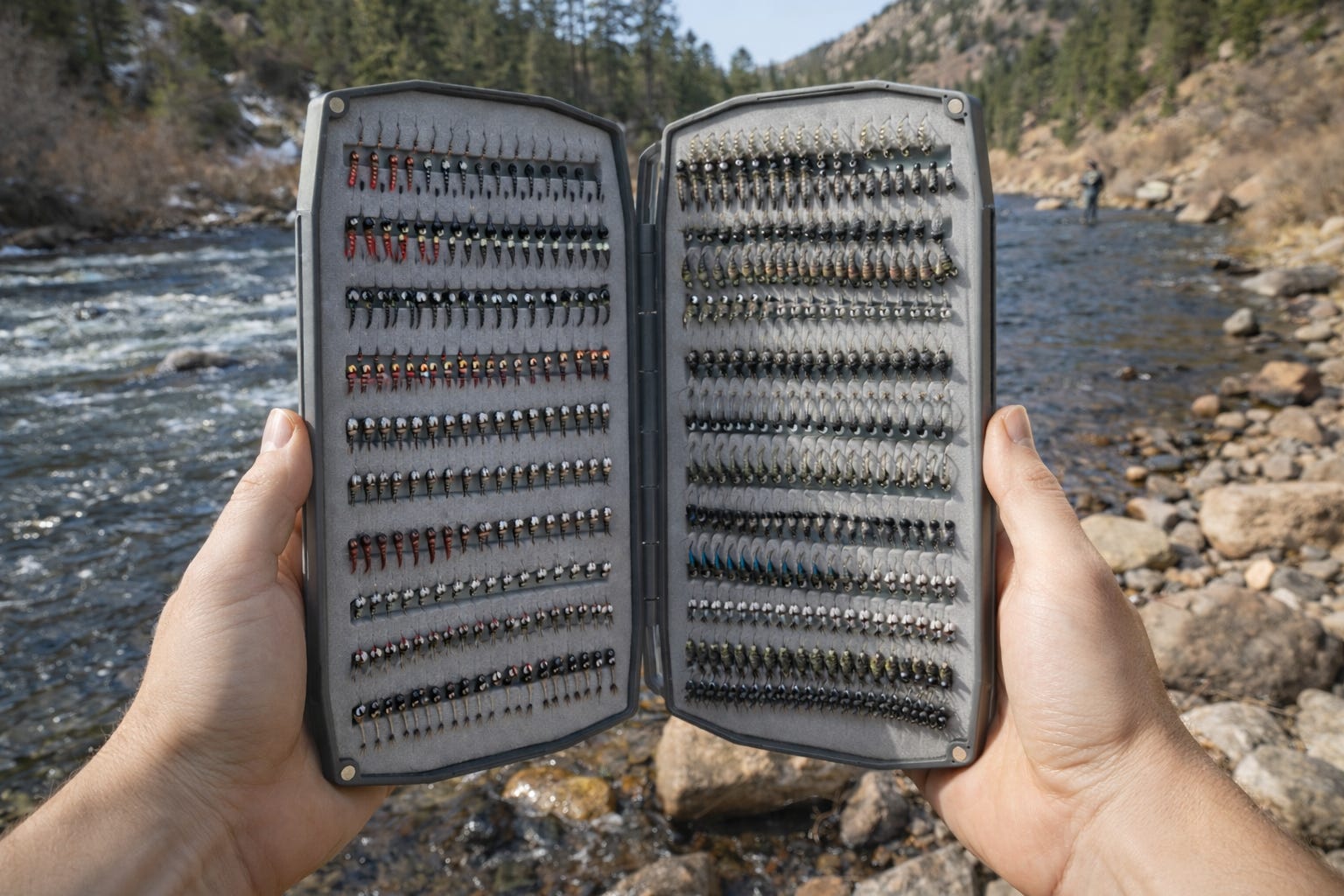
Ask most fly anglers what they know about midges and you’ll get a version of the same answer — small flies, thin tippet, the South Platte in winter. That’s not wrong. But it’s about ten percent of the story.
Midges are the most important food source in Colorado’s tailwater fisheries, full stop. Not the most important winter food source. The most important food source — in every month of the year, in every condition, at every time of day. A trout that lives its entire life on the South Platte eats more midges than everything else in its diet combined. Understanding the midge at a biological level — not just knowing what flies to tie on — changes how you fish every single day on Colorado tailwater.
What Is a Midge
The word “midge” gets used loosely in fly fishing to mean any small fly, which creates confusion. In entomological terms, midges belong to the order Diptera — the true flies — and the family Chironomidae specifically. They are not mayflies. They are not caddisflies. They are true flies, related to house flies and mosquitoes, and they share the complete metamorphosis lifecycle of that order: egg, larva, pupa, adult.
This distinction matters because the lifecycle of a chironomid midge is fundamentally different from a mayfly or caddis, and fishing it effectively requires understanding those differences. Mayfly nymphs live on the bottom and swim to the surface to hatch. Midge larvae live in the substrate, often in silk tubes built into silt and organic matter on the riverbed, and their emergence journey is significantly more complex and drawn out than a mayfly hatch.
There are thousands of species of chironomid midges worldwide. On Colorado tailwaters the relevant species are small — sizes 18 through 26 most commonly, with some important species in the 22-26 range on heavily pressured water like Cheesman Canyon. Colors range from blood red, which gets its color from hemoglobin the larvae use to process oxygen in low-oxygen environments, to olive, brown, black, gray, and cream. Knowing which color dominates in a particular tailwater at a particular time of year is one of the most useful pieces of river-specific knowledge a guide accumulates over years on the water.
The Lifecycle — Where Fish Feed and Why
Understanding the complete midge lifecycle is the key to understanding where in the water column to present your fly at any given moment. Fish eat midges at every stage — larva, pupa, emerger, and adult — and knowing which stage is dominant in any given feeding situation determines everything about your approach.
The Larva
Midge larvae live on the bottom, in the substrate, in the silt-heavy soft spots of the riverbed that many anglers overlook entirely. They are worm-like in appearance — segmented, thin, and often slightly curved. On the South Platte, red larvae — commonly called bloodworms — are highly productive patterns year-round because the bottom composition of the river supports large populations of hemoglobin-rich species.
Larvae become available to fish when they are dislodged from the substrate by current, by the burrowing activity of other organisms, or as part of the pre-emergence process when they become active and begin moving toward the surface. Trout holding near the bottom, tailing in shallow water, or making subtle feeding movements without visibly rising are almost always eating larvae. A size 22 red larva fished dead drift along the bottom on a long dropper is one of the most consistently productive rigs in Colorado tailwater fishing.
The Pupa
The pupal stage is where the midge hatch becomes most fishable — and most technical. When a midge larva is ready to emerge it transforms into a pupa inside its larval case on the riverbed, then begins its ascent to the surface. This ascent is not quick. A midge pupa can spend a significant amount of time ascending, often using a trapped gas bubble to help it rise, and it is available to fish throughout the entire journey from the bottom to the surface film.
The pupa looks dramatically different from the larva — it has a distinct thorax, visible wing pads, and often a gas bubble trapped beneath the thoracic shuck that gives it a slightly silvery or glassy appearance. This gas bubble is critically important for fly selection. Patterns that incorporate a glass bead, a silver or clear thorax material, or a flashback element are imitating this bubble and triggering takes specifically because of it.
As the pupa ascends it moves through the entire water column — and trout will intercept it at any depth. This is why indicator nymphing and tight line nymphing are so effective during a midge hatch on the South Platte — the fish aren’t just feeding at the surface. They’re feeding at two feet, at four feet, at six feet, wherever the rising pupae happen to be when the fish decides to eat.
The Emerger and the Film
This is where midge fishing gets genuinely complex — and genuinely exciting. When the ascending pupa reaches the surface it must break through the surface film to shed its shuck and emerge as a winged adult. This is not an instantaneous process. The pupa hangs in or just below the film, partially emerged, often for an extended period. The shuck is still attached. The wings are folding out. The adult is becoming.
During this suspended stage the midge is at its most vulnerable and the fish know it. A midge pupa hanging in the film cannot escape. Trout that are feeding in the film during a midge hatch are making the most energy-efficient decision available to them — stationary prey, no chase required, high density of available food. This explains the subtle, almost imperceptible sipping rises you see during heavy midge hatches on the South Platte. The fish are barely moving. The food is coming to them.
Fishing the film during a midge hatch is arguably the most technical fly fishing Colorado tailwaters offer. The fly must be in the film — not below it, not skating across it, flush in it. The drift must be perfect. The tippet must be invisible. And you’re fishing size 22-26 patterns to fish that have seen thousands of artificial flies. It is difficult, demanding, and when it works, deeply satisfying.
The Adult
The adult midge is a winged insect that closely resembles a mosquito in profile — slim body, delicate wings held flat over the back, long legs. Adults are present on the water surface immediately after emergence and again when females return to lay eggs, dipping to the surface to deposit eggs before dying.
Adult midges cluster on the surface in what are called midge clusters — multiple insects grouped together on the film, either mating or in the process of egg laying. These clusters are significant food sources because they offer a larger profile and more calories than a single adult midge. Patterns like the Griffith’s Gnat — a sparse peacock herl fly with a grizzly hackle palmered through it — were specifically designed to imitate a midge cluster and remain one of the most effective surface patterns in tailwater fishing for exactly this reason.
Seasonal Patterns on Colorado Tailwaters
One of the defining characteristics of midges on Colorado tailwaters is their year-round availability. Unlike mayflies and caddisflies, which have distinct seasonal windows, midges hatch in every month of the year on the South Platte, the Gunnison, and Colorado’s other regulated tailwater fisheries. This is what makes midges so foundational — when nothing else is hatching, midges are. Always.
That said, midge activity is not uniform across seasons. Understanding the seasonal patterns helps you approach the hatch with better-calibrated expectations.
Winter — November through February
Winter is peak midge time on Colorado tailwaters. With water temperatures in the low 40s and no competition from mayflies or caddisflies, midges dominate the food supply completely. Fish are feeding almost exclusively on midges in some form — larva, pupa, or emerger — throughout the day.
Winter midge hatches on the South Platte often peak during the warmest part of the day, typically between 11 AM and 2 PM when air temperatures are highest and the fish are most active. The hatch can be dense — clouds of adults hovering over the water, fish rising steadily in every flat and glide. This is one of the genuine joys of winter tailwater fishing in Colorado and worth every cold finger it costs you to experience it.
Fly selection in winter leans toward smaller, more precise patterns. Size 22-26 larvae and pupae. Mercury patterns with glass beads to imitate the gas bubble. Thin wire hooks that don’t distort small patterns. The RS2 and its variations are among the most effective winter midge patterns on the South Platte, imitating the emerging pupa or stuck-in-the-shuck stage with minimalist precision.
Spring — March through May
As water temperatures begin to climb in spring and baetis mayflies come online, midges share the menu rather than dominating it. The most technically interesting fishing of the year often happens during spring when fish are eating midges and baetis simultaneously and you need to determine which is the primary food source before you can fish effectively.
Look at the rise forms. Midges in the film produce subtle, deliberate sips. Baetis duns produce a slightly more aggressive, sometimes splashier rise as the fish tips up to intercept a larger, faster-moving fly. When both are on the water, the fish will often key selectively on one or the other — and presenting the wrong imitation during a heavy hatch of either produces consistent refusals no matter how good your drift is.
Summer — June through August
Summer midges on tailwaters are an early and late game. As water temperatures climb through the day, midge activity shifts to the cooler hours — early morning before 9 AM and evening after 6 PM. This aligns with the temperature-based conservation practices discussed in the drought year article — if you’re fishing a thermometer-monitored tailwater in summer, the midge hatch windows conveniently align with the ethical fishing windows.
Summer midges also tend to run slightly larger than winter patterns — sizes 18-22 are more common — as the warmer water temperatures accelerate development. Midge clusters become more important in summer as adult activity increases and fish key on the larger profile of the cluster rather than the individual adult.
Fall — September through October
Fall is a transition period. Midge activity remains strong throughout the fall on most Colorado tailwaters, and as caddis and trico hatches wind down, midges reclaim more of the fish’s dietary attention. Fall midge fishing on the South Platte can be exceptional — fish that have been pressured all summer respond well to well-presented midge patterns as crowds thin and the canyon quiets down.
The Patterns That Matter
Entire books have been written on midge patterns and there are hundreds of effective flies. Rather than a comprehensive catalog, here are the patterns worth understanding at a conceptual level — what they imitate and why they work.
Larva patterns
Should be slim, segmented, and in the right color for the water you’re fishing. Red — bloodworm — is the default starting point on the South Platte. Olive and brown larvae are more important on the Gunnison. A slight curve in the hook gives a more natural presentation. Size 22-24.
Pupa patterns
Need three things to work: the right profile, the right color, and something to suggest the gas bubble. This is where the glass bead or mercury bead earns its place — not as a weight mechanism but as a visual trigger. The Mercury Black Beauty, the Mercury Midge, the Jujubee Midge — all of these patterns work because of the bead, not in spite of it. Size 20-24.
Emerger and film patterns
Need to sit in or just below the surface, and this is where pattern selection gets genuinely specific. The Black Beauty — a simple black thread body with a silver bead — is as close to a universal South Platte midge pattern as exists, fishing effectively as both a pupa and an emerger depending on how it’s rigged. The WD40, with its slim dubbed body and sparse wing case, imitates the partially emerged pupa hanging in the film with understated precision — one of those patterns that looks like almost nothing at the vise and catches fish everywhere. The Zebra Midge — black thread, silver wire rib, silver or tungsten bead — covers the ascending pupa stage and is worth having in sizes 20-26 in every tailwater box in Colorado.
For true film fishing, CDC-based patterns are in a category of their own. CDC — cul de canard — is harvested from the feathers surrounding a duck’s preen gland and is naturally water-resistant and buoyant in a way no synthetic material fully replicates. A CDC fiber in the film sits exactly the way a midge shuck sits in the film — flush, trapped, barely breaking the surface. The CDC Transitional Midge takes this a step further by imitating the midge mid-emergence, shuck trailing, adult partially formed — the most vulnerable and most imitated moment of the entire lifecycle. The Top Secret Midge, developed by Pat Dorsey specifically for South Platte conditions, combines a slim segmented body with an emerging CDC wing that mimics this same transitional stage with a profile so accurate it has become one of the defining patterns of Front Range tailwater fishing. Size 22-26 across all of these — and fish them flush, not high-floating.
Adult and cluster patterns
The Griffith’s Gnat is the essential cluster pattern. For individual adults a simple parachute midge in gray or black, size 22-24, is all you need. Fish these flush in the film, not high-floating.
Reading the Hatch in Real Time
The most important skill in midge fishing is not fly selection — it’s observation. Before you tie anything on, watch the water for five minutes. Where are the fish rising? How are they rising? What’s on the surface? What’s in the film?
A fish that’s making a subtle barely-visible sip is eating in the film — emerger or adult. A fish that’s not rising at all but is clearly active is eating subsurface — larva or pupa. A fish that’s making a quicker, more decisive rise with a visible head break is likely eating an adult or cluster.
Match what you see happening to the stage of the lifecycle that produces it. Then get your fly into the right position in the water column — because a perfect pupa imitation drifting six inches too deep during a heavy film hatch will get ignored by every fish in the run, no matter how well you tie it.
The midge is not a simple fly. It is the foundational food source of Colorado’s greatest tailwater fisheries, a year-round constant in the diet of the fish you’re chasing, and a hatch that rewards the angler who takes the time to understand it at every stage. Learn the lifecycle. Learn to read which stage is dominant. Match the right pattern to the right position in the water column with the right presentation.
Everything else is just casting.
Pattern Quick Reference
Larva: Red Larva, Zebra Midge (red/black), Brassie — sizes 22-24
Pupa: Mercury Black Beauty, Jujubee Midge, WD40, Mayer’s Midge — sizes 20-24
Emerger/Film: Black Beauty (unweighted), WD40, CDC Transitional Midge, Top Secret Midge — sizes 22-26
Adult/Cluster: Griffith’s Gnat, Parachute Midge (gray or black) — sizes 20-24
Every week Pocket Water CO publishes a South Platte fishing report – current flows, water temps, hatch timing, and section-by-section tactics for Deckers, Cheesman, Eleven Mile, and the Dream Stream. If you fish Colorado water — especially the South Platte tailwaters — this is the report you want before you leave the house. $8/month or $80 for the full season. Less than a box of flies.