

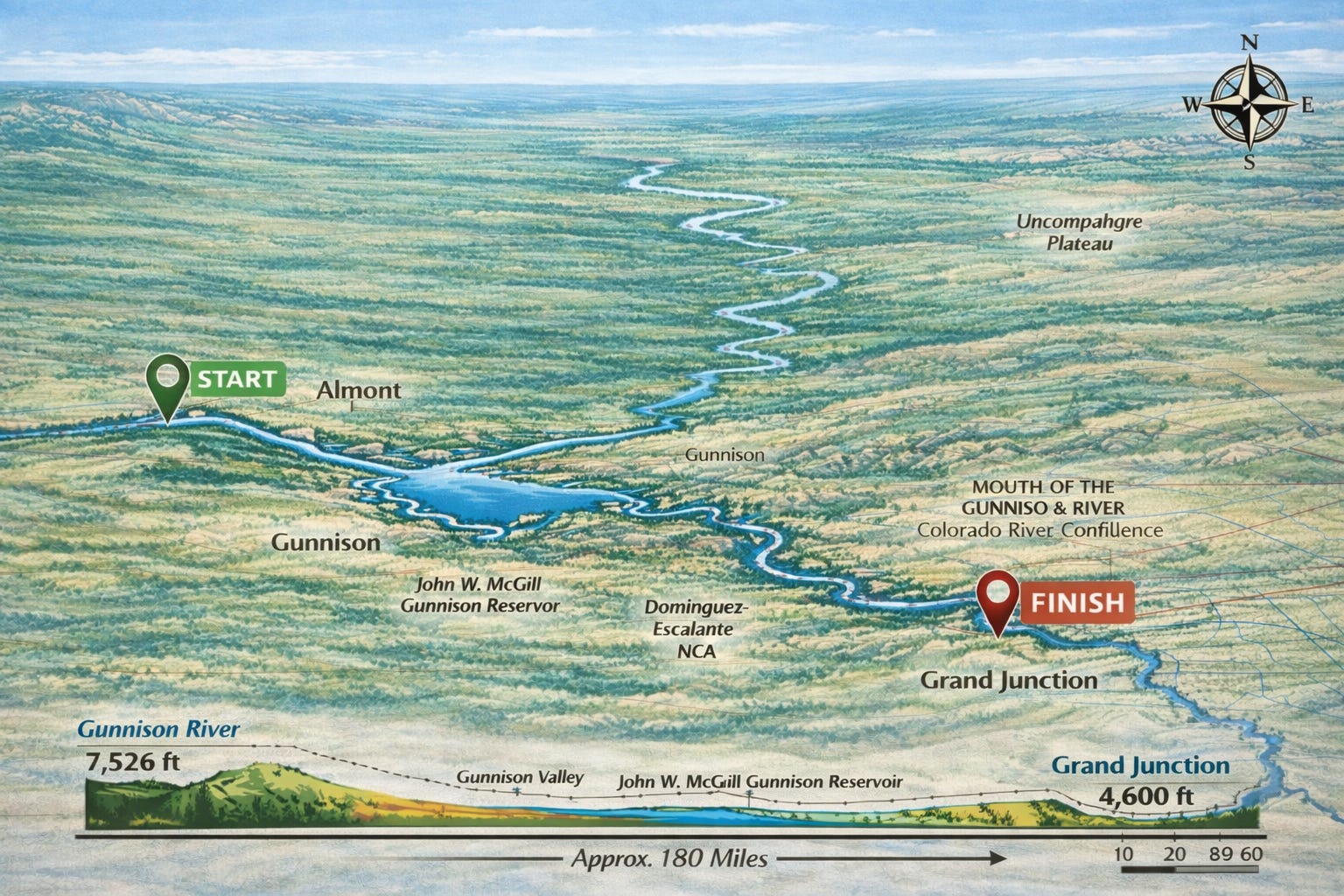
The Gunnison River is not a river you stumble into. It doesn’t sit next to an interstate. It doesn’t have a well-worn parking area with a manicured path to the bank. To fish it well — really well — you have to know it, and knowing it takes time.
The Gunny, and all of its various personalities, hold a special place in my heart. I’ve floated the Gorge more times than I can count, hiked the East Portal on days when the canyon walls blocked the sun until nine in the morning, waded the upper stretches at Almont in a wind that reminded me this is still high country. Every section is a different river. Every season reshuffles the deck. And the fish — particularly in the canyon sections — are some of the largest, wildest, and most demanding trout you will encounter anywhere in the American West.
This is not a trailhead-and-parking guide. That information exists elsewhere and it will lead you to the same popular pullouts every other angler is standing at. What this is — what I’ve tried to make it — is a working document. A guide to understanding how the Gunnison behaves across its 180 miles, why each section fishes the way it does, what the regulations require, and what the river’s fish demand of you before they’ll eat your fly.
Pocket Water CO focuses on the Gunnison from Almont downstream through the Gunnison Gorge. The upper section, the canyon sections, the Gorge. The water that earns the river its reputation.
The River at a Glance
The Gunnison River forms at Almont, Colorado, where the Taylor River and the East River converge at roughly 7,900 feet elevation. The Taylor drops out of Taylor Park — a high-altitude reservoir that creates one of Colorado’s most celebrated tailwater fisheries just upstream of the confluence. The East River drains from Emerald Lake near Crested Butte, a true freestone stream running cold off the high peaks. Together they form a river that, from its first mile, is already carrying the genetic material of two distinct and exceptional fisheries.
From Almont, the upper Gunnison flows generally southwest through a wide, agricultural valley lined with cottonwoods and ranch land for roughly 20 miles before spilling into Blue Mesa Reservoir — the largest body of water in Colorado, famous in its own right for a renowned kokanee salmon fishery and trophy lake trout. Below Blue Mesa, the river is captured twice more by Morrow Point and Crystal Reservoirs before escaping Crystal Dam and entering the most dramatic terrain in Colorado: the Black Canyon of the Gunnison National Park, and downstream from it, the Gunnison Gorge Wilderness Area.
What makes the Gunnison exceptional as a trout fishery is the combination of wild fish genetics, extraordinary insect diversity, cold tailwater temperatures maintained by deep-release dams, and a canyon system that keeps the river largely inaccessible — which means the fish in the most protected reaches have never seen the pressure that defines places like Deckers or the Dream Stream. The Gold Medal designation covers the entire lower river from 200 yards below Crystal Dam downstream to the North Fork of the Gunnison, and includes some of the most productive trout water in the continental United States.
The trout are here. The terrain between you and them is the question.
Regulations — Know Before You Go
The Gunnison’s regulations vary substantially by section and are worth studying before you load the truck. I practice catch and release everywhere I guide on this river regardless of what the law allows — the fish are a resource worth protecting and on Gold Medal water, keeping fish from the most productive stretches serves no one. That said, here is the current regulatory framework as established by Colorado Parks and Wildlife:
Upper Gunnison — Almont to Blue Mesa Reservoir
Wild Trout water designation. Artificial flies and lures only. Bag and possession limit is 2 trout. All cutthroat and cutbow trout must be returned to water immediately. The section has generous limits but is worth treating as catch and release given the quality of the fishery and the wild trout designation.
Black Canyon of the Gunnison National Park — East Portal Section
Artificial flies and lures only. No fishing within 200 yards downstream of Crystal Dam. All rainbow trout must be returned to water immediately. Bag limit for brown trout is 4 fish per day. A National Park entrance fee applies. East Portal Road is subject to seasonal closure — check with the park service before making the drive. A Colorado fishing license is required in addition to park access.
Gunnison Gorge Wilderness Area
Gold Medal Water. Artificial flies and lures only. All rainbow trout must be returned to water immediately. Brown trout bag limit applies. Access requires hiking one of four designated wilderness trails — this is not float-in-from-a-parking-lot water. Float fishing is permitted and the Gorge is Colorado’s marquee fly fishing float trip; permits and outfitter regulations apply if using a guide service for overnight trips. A Colorado fishing license is required.
North Fork of the Gunnison River
Artificial flies and lures only. All rainbow trout must be returned to water immediately. Brown trout between 12 and 16 inches must be immediately released. Bag limit for brown trout is either four fish no greater than 12 inches, or three fish no greater than 12 inches and one fish at least 16 inches. Verify current rules at cpw.state.co.us before fishing.
A valid Colorado fishing license is required on all sections, plus a Habitat Stamp for anglers ages 18–64. Always verify current regulations at cpw.state.co.us before your trip — rules change year to year and the Gunnison’s canyon sections have additional permit and access requirements that can catch unprepared anglers off-guard.
Conservation — Beyond the Regulations
Regulations are the floor. Here is what fishing this river responsibly looks like in practice:
Practice catch and release everywhere. Even where the regulations permit harvest, this is Gold Medal Wild Trout water. Release everything.
Use barbless hooks. The canyon sections involve long hikes and remote water. A deeply hooked fish that’s difficult to release is a fish that may not survive. Crimp your barbs at the truck.
Clean, drain, and dry all gear between river visits. New Zealand mudsnails have been documented in the Gunnison drainage. Felt-soled waders trap and transport aquatic nuisance species. Use rubber-soled boots with studs.
Monitor water temperatures. The Gunnison’s tailwater sections maintain cold temperatures year-round, but the upper freestone sections and lower canyon edges can warm dangerously in drought years. Stop fishing when water temps reach 65°F. Carry a thermometer.
Respect wilderness boundaries. The Gunnison Gorge Wilderness is managed as primitive wilderness. Pack out everything you pack in. Leave no fire rings. Camp only in designated sites.
Give wildlife space. The canyon sections support bighorn sheep, river otters, peregrine falcons, and bald eagles. These animals belong here more than we do. Keep distance and keep noise down.
Wet your hands before touching fish. Two seconds for a photo, not ten. Keep them in the water as much as possible and never squeeze a fish around its midsection.
Water Temperatures — What to Expect by Season
The Gunnison’s canyon sections benefit from cold tailwater releases from Crystal Reservoir, which maintains stable temperatures even during summer heat. The upper freestone section above Blue Mesa is more variable and responds directly to snowmelt and seasonal air temperatures.
Winter (December–February)
Canyon sections at the East Portal and Gorge hold in the low-to-mid 40s °F, cold enough to slow metabolism but not cold enough to stop feeding. The upper Gunnison can push into the high 30s during extreme cold snaps. East Portal Road is typically closed in winter, limiting canyon access to hike-in only. The lower Gorge sections remain productive on midday feeding windows when light penetrates the canyon walls.
Spring (March–May)
Water temperatures climb from the low 40s toward the low 50s as the season progresses. This is when early hatches begin in earnest — blue-winged olives and midges come online through March and April, with caddis and early stonefly activity building through May. Pre-runoff conditions can offer exceptional nymphing. Watch runoff timing carefully: the upper Gunnison blows out faster than the tailwater-buffered canyon sections.
Summer (June–August)
Canyon tailwater sections hold in the mid-50s to low 60s °F, ideal for trout. The upper Gunnison above Blue Mesa warms into the mid-60s on summer afternoons — manageable but worth monitoring in drought years. Fish early and late on the upper sections. The canyon sections offer shade and cold water through the day, and summer is when the Gunnison’s insect diversity is at its peak.
Fall (September–November)
Temperatures drop back through the 50s and into the 40s by November. Brown trout enter pre-spawn aggression. The kokanee salmon run up from Blue Mesa through the upper Gunnison creates a secondary feeding frenzy as big browns and rainbows follow the salmon and pick off eggs. This is among the most dynamic and rewarding fishing the river offers all year.
Flows — What to Expect by Season
Flow management on the Gunnison is driven by the interplay of municipal water demands, irrigation priorities, and reservoir storage across a complex multi-reservoir system. Check USGS WaterWatch before every trip. The gauge “Gunnison River below Gunnison Tunnel” is the key reference point for canyon section planning.
Winter
Canyon sections typically run 200–400 CFS through the East Portal and Gorge during low-water winter periods. These are wadeable, sight-friendly conditions where presentation discipline is everything. The upper Gunnison near Almont runs lower — sometimes below 200 CFS — concentrating fish in deeper holding water.
Spring Runoff (May–June)
This is where the Gunnison’s freestone character asserts itself on the upper section. Flows can push 1,500–3,000 CFS or higher during peak runoff above Blue Mesa, making wading dangerous and visibility poor. The tailwater canyon sections are partially buffered by reservoir management but can still run high and off-color during extreme runoff years. The salmonfly hatch — the river’s signature event — often coincides with variable flows in the Gorge. Timing is everything.
Summer
Post-runoff flows settle to 400–800 CFS through the canyon sections. Optimal float conditions. The upper Gunnison returns to wade-friendly levels of 200–500 CFS. This is the heart of the season for both float fishing in the Gorge and wade fishing the upper river.
Fall
Flows mirror late summer conditions and often drop further as irrigation demand decreases — 100–400 CFS in the canyon sections is common by October. Lower, clearer water combined with aggressive pre-spawn fish makes fall the best all-around season on the Gunnison.
Note on 2026: Given below-average snowpack across the Gunnison basin this winter, expect lower-than-normal flows through summer. Reservoir storage heading into summer is below historical averages. Canyon sections will be fishable but plan for clearer, shallower conditions than typical. The upper freestone sections may see runoff that is compressed and shorter than normal.
The Sections — Almont to the Gorge
The Upper Gunnison — Almont to Blue Mesa Reservoir
The upper Gunnison begins at the confluence of the Taylor and East Rivers in the small community of Almont, sitting at 7,900 feet between Gunnison and Crested Butte. This is the most accessible stretch of the river — Highway 135 parallels much of it — and the most varied in character. Twenty miles of riffles, runs, deep pools, and cottonwood-lined banks with abundant public access points managed by Colorado Parks and Wildlife and the BLM.
The fish here are a mix of wild and stocked rainbows and wild browns, averaging 9 to 17 inches with genuine opportunities for 20-inch fish, particularly in the deeper pools near private water boundaries. The section fishes best from a drift boat during high water in spring and early summer; wade fishing from BLM access points is excellent from midsummer through fall when flows drop. This is where the Green Drake hatch reaches its peak in late June through mid-July — one of the best dry fly events in the state.
The fall kokanee salmon run is the upper Gunnison’s signature event. Beginning in August and running through October, landlocked sockeye from Blue Mesa push upstream toward the Roaring Judy Fish Hatchery on the East River. Big browns and rainbows follow the salmon to feed on eggs. Catch and release applies to the kokanee; the trout following them do not. This is an experience unlike anything else on Colorado’s trout rivers.
Access is off Highway 135 north of Gunnison. Almont itself has a resort and campground with river access. The BLM maintains multiple access points downstream — look for the brown roadside signs. Most of this water is straightforward to reach, which means it receives proportionally more pressure than the canyon sections. Weekday fishing and early starts are rewarded.
Blue Mesa Reservoir
Blue Mesa is not a trout stream in the traditional sense — it is a 20-mile stillwater fishery that happens to sit in one of the most scenic settings in Colorado, with the West Elk Mountains on one side and the Black Canyon country rising on the other. The kokanee fishery is exceptional, with fish that can run 15 to 18 inches by late summer. Rainbow, brown, and lake trout are present in numbers. Boat fishing is the primary approach; kayak and float tube access is possible in the upper arms. Snagging of kokanee is permitted from November 1 through December 31 — check CPW regulations for current rules.
If you are driving US-50 toward Montrose and you have never stopped to look at Blue Mesa from the overlooks above the dam, stop. The view alone is worth the detour.
The East Portal — Black Canyon of the Gunnison National Park
Below Blue Mesa, the Gunnison passes through Morrow Point and Crystal Reservoirs before Crystal Dam releases it into the Black Canyon proper. The East Portal is the only drive-to access point inside the national park, reached via East Portal Road off Colorado Highway 347 near Montrose. The road descends steeply to the river — roughly two miles of winding, narrow pavement that should not be attempted with anything larger than a standard pickup truck. It is subject to seasonal closure, typically reopening in spring once the road is clear. Check with the park before making the drive.
What you find at the bottom of that road is a tailwater fishery below Crystal Dam that fishes unlike anything else on the Gunnison. The canyon walls at the East Portal rise 2,000 feet above the river. Light reaches the water for only a few hours in the middle of the day, even in summer. The fish — browns averaging 14 to 17 inches with regulars pushing 20 to 22 inches — are wild, educated, and holding in water that is cold, clear, and technically demanding. The East Portal is not a high-volume fishing day. It is a precision day. One good fish here is worth ten from a pressured parking-lot stretch.
The salmonfly hatch reaches the East Portal last, typically late June into early July, after moving upstream through the Gorge over several weeks. Golden stones follow on its heels. Evening caddis hatches in June and July are heavy but short-lived — most day-trippers miss them entirely. If you want to fish the East Portal right, consider camping at the riverside sites and fishing the evening rise.
The Gunnison Gorge Wilderness Area
The Gunnison Gorge is what guides talk about when they want to explain what river fishing can be at its absolute best. Below the Black Canyon National Park boundary, the river flows through the BLM-managed Gunnison Gorge Wilderness Area for roughly 14 miles before reaching Pleasure Park and the put-out at the Gunnison Gorge National Conservation Area downstream. It is Colorado’s marquee fly fishing float trip. It is also, for walk-in anglers, one of the more physically demanding fishing days in the state.
The only access to the Gorge wilderness section is by hiking one of four designated trails — the Chukar Trail, Ute Trail, Bobcat Trail, and Duncan Trail. These trails descend from the canyon rim to the river, dropping several hundred feet over trail distances of one to three miles. They are not technical mountaineering but they are serious hiking in high desert terrain. Good footwear, plenty of water, and an honest assessment of your physical condition are required. The trail back out at the end of a long wading day, when your legs are already tired, is something you will feel the next morning.
What the access demands, the fishing repays. CPW electrofishing surveys have documented extraordinary trout densities in the Gorge, with rainbow trout regularly exceeding 20 inches and browns averaging larger than most Colorado rivers produce. The fish are wild, strong, and — compared to the South Platte canyon sections — less conditioned to fly fishing pressure. They can be caught on patterns that would be laughed off the water in Cheesman Canyon. This is still technical fishing on clear water, but the fish are willing in a way that canyon-pressured South Platte trout are not.
Float fishing the Gorge is the preferred approach for most visitors. The put-in at the East Portal or from one of the hiking trails, floating 14 miles of Class II-III water with guided overnight camps at riverside sites, is one of the great Colorado outdoor experiences. Wildlife — bighorn sheep on the canyon walls, river otters in the eddies, peregrine falcons on the rimrock above — makes it as much a natural history trip as a fishing trip. The outfitters operating in the Gorge have decades of experience on this water. Book early. This is popular.
The salmonfly hatch in the Gorge — which typically begins at Pleasure Park in late May and moves upstream over the following weeks — is the most anticipated fishing event on the western slope of Colorado. The air above the river during peak emergence is thick with insects the size of a man’s thumb. The fish are looking up and feeding aggressively in conditions that rarely exist on heavily pressured tailwaters. If you can hit it right, it is as good as fly fishing gets.
Tactics — Seasonal Approach
Winter (December–February)
Winter on the Gunnison is a disciplined game. The canyon sections at the East Portal and upper Gorge offer the most consistent winter fishing — tailwater temperatures hold in the low-to-mid 40s, fish stack in deeper holding lies, and the productive window concentrates in the midday hours when light reaches the canyon floor and midge activity increases. Expect fishing from 11 AM to 3 PM to represent the bulk of your opportunity.
Nymphing subsurface midge patterns is the technique. Zebra Midges, Mercury Black Beauties, and WD-40s in sizes 20–24 are the foundation. Two-fly rigs with a larva on point and a pupa on the dropper cover the column. 5X to lead, 6X to the dropper. When fish slide into the film on warm winter afternoons, cut the indicator rig and go to an RS2 or CDC emerger fished flush in the surface.
East Portal Road is typically closed in winter. The Gorge hiking trails remain open but conditions can be treacherous after snow and ice — traction devices for your boots are not optional. The upper Gunnison near Almont is accessible by road year-round and produces consistent nymphing in deeper troughs and inside bends during the warmest part of the day.
Spring (March–May)
Spring is when the Gunnison begins to reveal its full range. Blue-winged olives come online in March, overlapping with year-round midge activity, and the fish respond with surface feeding on overcast afternoons that is among the most reliable dry fly fishing of the year. Caddis begin hatching through April. By May, early stonefly nymphs are drifting and trout in the upper sections are feeding with increasing aggression as water temperatures climb.
Monitor the upper Gunnison’s runoff window carefully. The East River’s freestone character means the upper section can blow out quickly with warm weather and heavy snowmelt. The tailwater-buffered canyon sections hold longer. In runoff years, the East Portal and Gorge — fed by reservoir-regulated flows — may offer fishable conditions while the upper section is blown out and brown.
The migratory rainbow run out of Blue Mesa happens in late winter and early spring, pushing fish into the upper Gunnison to spawn before flowing back to the reservoir. These are often the largest fish of the year in the upper section. Sight fishing to visible spawning fish requires restraint as much as skill — leave fish actively on redds alone. Target the pre-spawn and post-spawn fish holding in adjacent pools and runs.
Summer (June–August)
Summer is the Gunnison at its most generous. The insect calendar peaks: salmonflies in late May and June moving through the Gorge and up to the East Portal; golden stones on their heels through late June and July; PMDs and green drakes on the upper river from late June through mid-August; evening caddis throughout; and hoppers along the grassy upper banks by July.
The canyon sections stay cold enough to fish through the day — the shade from the canyon walls is a significant factor. The upper Gunnison above Blue Mesa warrants temperature monitoring on afternoon sessions in drought years. Fish early and late on the upper stretches, particularly by late July and August.
Float fishing in the Gorge peaks in summer. Flows are in the optimal range, the fish are active and distributed throughout the water column, and the guided overnight trips through the wilderness section are booked solid through July and August. Book months in advance if this is your target.
Fall (September–November)
Fall is the Gunnison at its most dynamic. Three things happen simultaneously: brown trout enter pre-spawn aggression; the kokanee salmon run triggers feeding frenzies in the upper sections that draw the largest trout in the system; and blue-winged olive hatches fire on overcast afternoons with a reliability that makes late October some of the best dry fly fishing of the year.
Streamer fishing, rarely productive on the Gunnison at other times, becomes genuinely effective in October and November as big browns hunt aggressively before the spawn. A well-presented streamer swung through a deep Gorge pool or a long upper-river run will produce fish that never look at a streamer pattern in any other season. Fish heavy, fish dark, fish slow.
Crowds thin dramatically after Labor Day. The Gorge hiking trails — busy in summer — become quiet. The East Portal has campsites available. The upper river access points are half-empty on weekends that would have been elbow-to-elbow in July. The Gunnison in October is a different experience than any other month, and it is the month that people who have fished this river for decades talk about most.
Resources
Flows: USGS WaterWatch — waterwatch.usgs.gov (Gauge: Gunnison River Below Gunnison Tunnel)
Regulations: Colorado Parks and Wildlife — cpw.state.co.us
Black Canyon National Park: National Park Service — nps.gov/blca
Gunnison Gorge NCA permits: BLM Uncompahgre Field Office — blm.gov/office/uncompahgre-field-office